


Hypothyroidism vs Hyperthyroidism: Symptoms, Causes and Treatment
Hypothyroidism and hyperthyroidism are opposite problems of the thyroid, a small butterfly-shaped gland in the front of the neck whose hormones control how the body uses energy. In hypothyroidism, the thyroid makes too little hormone, which slows many body functions and can cause fatigue, weight gain and trouble tolerating cold. In hyperthyroidism, it makes too much, which speeds the body up and can cause weight loss, a rapid heartbeat and heat intolerance. Hashimoto’s disease is the most common cause of an underactive thyroid, and Graves’ disease is the most common cause of an overactive one. Both are diagnosed with blood tests, and both can be treated.
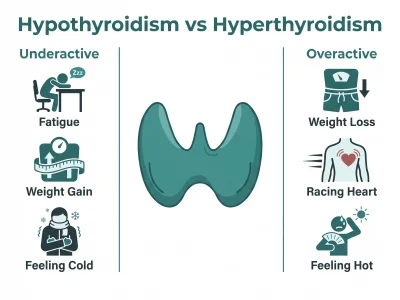
What Is the Difference Between Hypothyroidism and Hyperthyroidism?
Your thyroid is a small, butterfly-shaped gland in the front of your neck. Its hormones control the way your body uses energy, and they affect nearly every organ, including your breathing, heart rate, weight, digestion and mood.
Hypothyroidism means your thyroid does not make enough thyroid hormone to meet your body’s needs, so many body functions slow down. Hyperthyroidism means it makes more hormone than your body needs, so many functions speed up, including your heart rate. Nearly 5 in 100 Americans aged 12 and older have hypothyroidism, while about 1 in 100 have hyperthyroidism. Both are more common in women and in people over 60.
Other Thyroid Conditions
Thyroid problems are not limited to these two. Other common thyroid conditions include goiter (an enlarged thyroid), thyroid nodules (lumps in the gland), thyroiditis (inflammation of the thyroid) and thyroid cancer. Some of these can lead to an underactive or overactive thyroid.
Andrea Dean, CRNP, shares what she would do first after a hyperthyroidism or Graves’ disease diagnosis in this YouTube Short.
Hypothyroidism vs Hyperthyroidism Symptoms
Because one condition slows the body down and the other speeds it up, many symptoms are opposites. Some, like fatigue and period changes, can happen with both.
Common symptoms of hypothyroidism:
- Fatigue
- Weight gain
- Trouble tolerating cold
- Joint and muscle pain
- Dry skin or thinning hair
- Heavy or irregular periods, or fertility problems
- Slowed heart rate
- Depression
Common symptoms of hyperthyroidism:
- Weight loss, even with an increased appetite
- Rapid or irregular heartbeat
- Nervousness, irritability or trouble sleeping
- Fatigue
- Shaky hands or muscle weakness
- Sweating or trouble tolerating heat
- Frequent bowel movements
- An enlarged thyroid in the neck, called a goiter
Hypothyroidism develops slowly, so you may not notice symptoms for months or years. Fatigue and weight gain are common and do not always mean you have a thyroid problem. In older adults, hyperthyroidism can look different, with symptoms such as loss of appetite or withdrawal from other people, and it is sometimes mistaken for depression or dementia.
Complications if Left Untreated
Untreated hypothyroidism can contribute to high cholesterol. Rarely, severe untreated hypothyroidism leads to myxedema coma, a life-threatening condition that needs immediate treatment.
Untreated hyperthyroidism can cause an irregular heartbeat that may lead to blood clots, stroke and heart failure. It can also cause an eye disease called Graves’ ophthalmopathy, thinning bones and osteoporosis, muscle problems, and menstrual and fertility problems.
What Causes an Underactive or Overactive Thyroid?
Causes of Hypothyroidism
The most common cause of hypothyroidism is Hashimoto’s disease, an autoimmune disorder in which your immune system attacks your thyroid. Learn more on our Hashimoto’s thyroiditis page. Other causes include:
- Thyroiditis, or inflammation of the thyroid
- Congenital hypothyroidism, which is present at birth
- Surgery that removes part or all of the thyroid
- Radiation treatment of the thyroid
- Certain medicines, including some heart, bipolar disorder and cancer medicines
Less often, an iodine imbalance or a problem with the pituitary gland or hypothalamus is the cause. Iodine deficiency is extremely rare in the United States.
Causes of Hyperthyroidism
The most common cause of hyperthyroidism is Graves’ disease, in which your immune system attacks the thyroid and makes it overactive. Other causes include:
- Overactive thyroid nodules, usually noncancerous lumps that make extra hormone, most often in older adults
- Thyroiditis, which can leak stored thyroid hormone into the blood
- Too much iodine, from some cough syrups, heart medicines or seaweed
- Taking more thyroid hormone medicine than prescribed
- Rarely, a noncancerous tumor of the pituitary gland
Who Is More Likely to Develop a Thyroid Problem?
You are more likely to develop hypothyroidism if you have had a thyroid problem such as a goiter, thyroid surgery, radioactive iodine treatment or radiation to the neck or chest, a family history of thyroid disease, or a pregnancy in the past 6 months. It is also more likely if you have celiac disease, Sjögren’s syndrome, pernicious anemia, type 1 or type 2 diabetes, rheumatoid arthritis or lupus.
Hyperthyroidism is more likely if you have a family history of thyroid disease, pernicious anemia, type 1 or type 2 diabetes or primary adrenal insufficiency. Eating large amounts of iodine, using nicotine and being pregnant in the past 6 months also raise your risk.
How Thyroid Problems Are Diagnosed
Diagnosis starts with your medical history and a physical exam. Symptoms alone are not enough, because many of them overlap with other conditions, so blood tests and sometimes imaging tests are used to confirm the diagnosis and find the cause.
Common Thyroid Blood Tests
- TSH: The best first test of thyroid function. A high TSH suggests an underactive thyroid, and a low TSH usually suggests an overactive one.
- Free T4: Measures the unbound thyroid hormone that can act on your tissues. Together with TSH, it gives a more accurate picture.
- T3: Useful for diagnosing hyperthyroidism or judging how severe it is. It is rarely helpful in hypothyroidism, because it is the last test to become abnormal.
- Thyroid antibodies: TPO and thyroglobulin antibodies can point to Hashimoto’s thyroiditis. TSI antibodies can be positive in Graves’ disease.
Free T3 and Reverse T3
Free T3 can be measured, but the test is often unreliable, so it is not typically helpful. Reverse T3 is an inactive form of T3. In people who are not in the hospital, measuring reverse T3 does not help determine whether hypothyroidism exists, so it is not a routine test for diagnosing an underactive thyroid.
Thyroid Testing and Fertility
Thyroid problems can affect fertility, so women who have trouble getting pregnant are often tested for both hypothyroidism and hyperthyroidism.


How Hypothyroidism and Hyperthyroidism Are Treated
Treating Hypothyroidism
Hypothyroidism is treated by replacing the missing hormone with levothyroxine, a medicine identical to the T4 hormone a healthy thyroid makes. It is usually a daily pill, and it is often taken in the morning before eating. A blood test is done about 6 to 8 weeks after you start or change your dose, then every 6 months to a year once your dose is stable. Some people who do not feel better on T4 alone may also take liothyronine, a T3 medicine. Hypothyroidism can usually be fully controlled, and most people take thyroid medicine for life. Never stop taking it without talking with your provider first.
Calcium and iron supplements, antacids, biotin, estrogen and some seizure medicines can affect thyroid medicine, so tell us if you start or stop any of them. Taking too much thyroid hormone can cause atrial fibrillation or osteoporosis, which is why the dose is checked with blood tests.
Treating Hyperthyroidism
Treatment for hyperthyroidism depends on the cause, how severe it is, your age, pregnancy and other health conditions. Options include:
- Beta-blockers, which relieve a racing heart, tremor and nervousness, often within hours, but do not lower hormone production
- Antithyroid medicines, most often methimazole, which lower hormone production but are not a permanent cure and are often taken for 1 to 2 years
- Radioactive iodine, taken by mouth, which gradually destroys the cells that make thyroid hormone; nearly everyone treated this way eventually develops hypothyroidism and needs a daily hormone pill
- Thyroid surgery, used less often, which requires lifelong thyroid hormone medicine if the whole gland is removed
Iodine, Diet and Your Thyroid
Your thyroid uses iodine to make hormones, but people with Hashimoto’s disease, Graves’ disease or other autoimmune thyroid conditions may be sensitive to too much. Large amounts of kelp, dulse or other seaweed, or iodine supplements, may cause or worsen both hypothyroidism and hyperthyroidism. Ask us before taking iodine supplements, and check cough syrups and multivitamins, which may contain iodine.
Thyroid Problems During Pregnancy
Untreated hypothyroidism or severe untreated hyperthyroidism during pregnancy can affect both you and your baby. Thyroid medicines for hypothyroidism are considered safe in pregnancy, and many women need a higher dose, so contact your provider right away if you become pregnant. If you have hyperthyroidism and are planning a pregnancy, it is best to bring it under control first.
Hypothyroidism and Hyperthyroidism FAQs
Is Levothyroxine the Same as Synthroid?
Yes. Synthroid is a brand name for levothyroxine, the synthetic T4 medicine used to treat hypothyroidism. Other brands and generic versions contain the same hormone.
Is Armour Thyroid FDA Approved?
No. Armour Thyroid and NP Thyroid are animal-derived thyroid medicines, sometimes called desiccated thyroid extract, made from dried pig thyroid glands. They are not FDA approved, batches may not deliver consistent hormone levels, and professional medical guidelines recommend synthetic levothyroxine as the preferred treatment. If you take Armour Thyroid now, do not stop or switch without talking with your provider.
What Is Compounded T4 and T3?
Compounded thyroid medicine is prepared by a pharmacy for a specific patient, for example someone allergic to a dye in a standard pill. Compounded drugs are not FDA approved, so their safety, effectiveness and quality are not checked before they are dispensed. FDA-approved levothyroxine and liothyronine are the standard options.
What Is Methimazole?
Methimazole is the antithyroid medicine used most often for hyperthyroidism. It lowers how much hormone your thyroid makes. Side effects can include rashes, low white blood cell counts and, rarely, liver failure, so your provider monitors you while you take it.
Can Hyperthyroidism Turn Into Hypothyroidism?
It can after treatment. Nearly everyone treated with radioactive iodine eventually develops hypothyroidism, and removing the whole thyroid requires lifelong thyroid hormone medicine.
Should I Ask for a Reverse T3 Test?
Reverse T3 is not used to diagnose hypothyroidism in people who are not in the hospital. TSH and free T4 are the standard tests for diagnosis and for checking your dose.
Where Can I Find a Thyroid Specialist Near Me?
If you are searching for help with thyroid symptoms near Newark or elsewhere in Delaware, Renew Integrative Health can review your symptoms and lab work. Our holistic medicine practitioner, Andrea Dean, CRNP, will review your symptoms, history and lab work with you and talk through your options.
Have questions about an underactive or overactive thyroid? Our nurse practitioner in Newark, Delaware, can review your symptoms and lab work and talk through your options with you. Book your consultation below.