


Thyroid Disorders: Types, Symptoms and Treatment
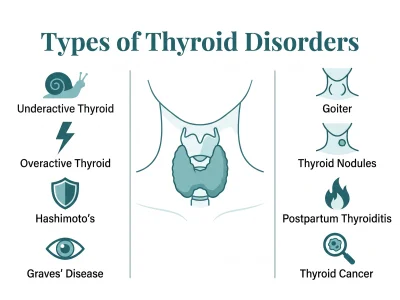
Thyroid disorders are conditions that make the thyroid, a small butterfly-shaped gland in the front of the neck, produce too much or too little thyroid hormone, or that change its size or structure. Thyroid hormones control how the body uses energy, so they affect breathing, heart rate, weight, digestion and mood. The main types are hypothyroidism, hyperthyroidism, Hashimoto’s disease, Graves’ disease, postpartum thyroiditis, goiter, thyroid nodules and thyroid cancer. Diagnosis uses a medical history, a physical exam and thyroid blood tests, starting with TSH, and sometimes an ultrasound or biopsy. Treatment depends on the problem and can include medicines, radioactive iodine or surgery.

Full thyroid history reviewed first
Thyroid labs before any plan
In person or virtual visits
What Are Thyroid Disorders?
Your thyroid is a small, butterfly-shaped gland in the front of your neck. It makes hormones that control the way your body uses energy, and those hormones affect nearly every organ, including your breathing, heart rate, weight, digestion and mood. Thyroid disorders, also called thyroid disease or thyroid problems, cause the thyroid to make too much or too little hormone, or cause the gland to swell, grow lumps or change in size.
This page is your guide to the whole family of thyroid disorders. Two of the most common have their own in-depth pages: hypothyroidism vs hyperthyroidism and Hashimoto’s thyroiditis.
What Does the Thyroid Do?
The thyroid’s job is to make thyroid hormones and release them into the blood, which carries them to every tissue in the body. Thyroid hormone helps the body use energy, stay warm and keep the brain, heart, muscles and other organs working as they should. The pituitary gland in the brain controls this with thyroid stimulating hormone, or TSH, which tells the thyroid how much hormone to make.
Thyroid Symptoms
Thyroid symptoms depend mostly on whether your thyroid hormone level is too low or too high. Many of them are easy to blame on stress or aging, which is why thyroid disorders are often missed.
Symptoms of an Underactive Thyroid
When thyroid hormone is too low, your body slows down. Typical symptoms include fatigue, weight gain, constipation, dry skin, depression and poor exercise tolerance.
Symptoms of an Overactive Thyroid
When thyroid hormone is too high, many of your body’s functions speed up. Symptoms can include weight loss despite a bigger appetite, a rapid or irregular heartbeat, nervousness, irritability, trouble sleeping, fatigue, shaky hands, muscle weakness, sweating or trouble tolerating heat and more frequent bowel movements.
Changes You Can See or Feel in Your Neck
Some thyroid disorders change the gland itself. An enlarged thyroid, called a goiter, may show as swelling at the front of the neck. A thyroid nodule is a lump in the thyroid, and some people notice one while looking in a mirror, buttoning a collar or fastening a necklace. Rarely, a large nodule can press on the windpipe or esophagus and cause trouble breathing or swallowing.
Types of Thyroid Disease
The thyroid can go wrong in several different ways, and some conditions overlap.
Hypothyroidism and Hyperthyroidism
Hypothyroidism means your thyroid makes too little hormone, and hyperthyroidism means it makes too much. Our hypothyroidism vs hyperthyroidism page covers the differences, causes, tests and treatment in depth.
Hashimoto’s Disease
Hashimoto’s disease is an autoimmune condition in which the immune system attacks the thyroid. It is the most common cause of hypothyroidism and a common cause of goiter in the United States. Read more on our Hashimoto’s thyroiditis page.
Graves’ Disease
Graves’ disease is an autoimmune disorder in which the immune system pushes the thyroid to make more hormone than your body needs. It affects nearly 1 in 100 Americans and causes about 4 out of 5 cases of hyperthyroidism in the United States. It is more common in women and in people older than 30, and more likely if you have a family history of Graves’ or Hashimoto’s disease, another autoimmune disorder or use nicotine. More than 1 in 3 people with Graves’ disease develop an eye condition called Graves’ ophthalmopathy, which can cause bulging, gritty or puffy eyes, light sensitivity and blurred or double vision. Untreated, Graves’ disease can lead to heart rhythm problems, thinning bones and problems with the menstrual cycle, fertility and pregnancy.
Postpartum Thyroiditis and Other Types
Inflammation of the thyroid comes in several forms. The most common is Hashimoto’s thyroiditis, an autoimmune condition with its own page. Antibodies cause most other types too, while infections and medicines such as interferon and amiodarone cause some. With several of these types, stored hormone leaks out first and causes overactive symptoms, then the thyroid runs low and causes underactive symptoms.
Postpartum thyroiditis happens after a baby is born. The overactive phase usually lasts 1 to 3 months, often followed by an underactive phase that can last up to 9 to 12 months. About 80% of people have normal thyroid function again within 12 to 18 months after symptoms start. Painless thyroiditis follows the same course in people who have not recently been pregnant, and subacute thyroiditis often comes with pain in the thyroid.
Goiter
A goiter is an enlarged thyroid gland. Worldwide, iodine deficiency is one of the most common causes, but it is no longer common in the United States, where Hashimoto’s disease and Graves’ disease are more common causes. A multinodular goiter is enlarged by one or more nodules, and its cause is not well understood.
Thyroid Nodules
Thyroid nodules are lumps in the thyroid, and they are extremely common. By age 60, about half of all people have one that can be found on an exam or imaging, and over 90% are benign. Most cause no symptoms and are found by chance on an exam or a scan done for another reason. Thyroid blood tests are usually normal, even when cancer is present in a nodule, so evaluation often includes a thyroid ultrasound and sometimes a fine needle biopsy.
Thyroid Cancer
Thyroid cancer is relatively uncommon compared with other cancers. Papillary thyroid cancer is the most common type, making up about 70% to 80% of cases, and follicular cancer makes up about 10% to 15%. Thyroid cancer is usually very treatable and is often cured with surgery and, when needed, radioactive iodine, and the outlook for most people with papillary and follicular thyroid cancer is excellent.
Thyroid Conditions We Treat
These pages go deeper into the thyroid conditions we see most often. Each one covers symptoms, causes, testing and treatment, along with how we approach care at Renew.
Hypothyroidism & Hyperthyroidism
Hypothyroidism means your thyroid makes too little hormone and hyperthyroidism means it makes too much. Learn how to tell them apart, what causes each and how they are treated.
Hashimoto's
Hashimoto’s disease is an autoimmune disorder in which the immune system attacks the thyroid. It is the most common cause of an underactive thyroid in the United States.
TSH Levels and Thyroid Testing
To diagnose a thyroid disorder, your provider uses your medical history, a physical exam and thyroid tests. TSH is usually checked first. A high TSH level most often means hypothyroidism, because the pituitary keeps calling for more hormone, and a low TSH level usually means hyperthyroidism. If TSH is not normal, at least one more test, such as free T4, helps find the cause. Pregnancy, birth control pills, severe illness and corticosteroids can all shift thyroid hormone results, so they are read in context. Antibody tests can point to Hashimoto’s or Graves’ disease, and an ultrasound shows the size of the gland and any nodules. Our hypothyroidism vs hyperthyroidism page walks through each thyroid blood test in detail.
Thyroid Disease Treatment
Treatment depends on the problem, how severe it is and your symptoms.
- Underactive thyroid: a daily thyroid hormone medicine replaces what your thyroid no longer makes, with blood tests to fine-tune the dose.
- Overactive thyroid: beta-blockers can ease a racing heart and shakiness within hours. Antithyroid medicines, most often methimazole, lower hormone production and are usually taken for 1 to 2 years. Radioactive iodine and thyroid surgery are longer-term options.
- Postpartum and painless thyroiditis: during an overactive phase, beta-blockers can ease a fast heart rate and tremor. Antithyroid medicines are not used, because the thyroid is not truly overactive. Thyroid hormone is used if an underactive phase causes symptoms, often for about 6 to 12 months before tapering.
- Goiter: treatment depends on the cause. If the goiter comes from Hashimoto’s and an underactive thyroid, a daily thyroid hormone pill restores hormone levels and usually keeps the goiter from growing. Surgery is not routine.
- Thyroid nodules: nodules that are benign or too small to biopsy are still watched with an ultrasound every 6 to 12 months. Nodules that are cancerous or suspicious are usually removed by an experienced thyroid surgeon.


How We Care for Thyroid Disorders at Renew
Thyroid care at Renew Integrative Health starts with listening. Your first visit includes an extensive history, including family history of thyroid and autoimmune disease, a physical examination with a check of your neck and a review of your thyroid labs. If you have not had a full thyroid panel, we order the tests that fit your symptoms.
From there, we build a plan around you. It may include thyroid hormone medicine along with nutrition and lifestyle support, with close follow-up and repeat labs until your dose and symptoms are where they should be. If you have Graves’ disease that needs radioactive iodine or surgery, or a nodule that needs a biopsy, we work alongside your endocrinologist or surgeon.
How to Prepare for Your Appointment
Before your first visit, complete your medical history, diet log and current symptoms through our patient portal, along with the previous two years of medical testing, including any thyroid blood tests or ultrasounds. Bring a list of every medicine and supplement you take, especially iodine, kelp, biotin, iron or calcium, since they can affect thyroid tests and treatment. We offer in-person visits at our Newark, Delaware office and virtual consultations across the United States.
Thyroid Disorders FAQs
Are Thyroid Problems More Common in Women?
Yes. Hashimoto’s disease is 4 to 10 times more common in women than men, and Graves’ disease is also more common in women. Postpartum thyroiditis affects women after pregnancy.
Can Thyroid Problems Cause Weight Gain?
Yes. An underactive thyroid slows your body down and can cause weight gain, while an overactive thyroid often causes weight loss despite a bigger appetite.
Is a Thyroid Nodule Cancer?
Usually not. Over 90% of thyroid nodules are benign. Because thyroid blood tests are often normal even when a nodule is cancerous, an ultrasound and sometimes a biopsy are used to check. Benign nodules are still watched with an ultrasound every 6 to 12 months.
Is a Goiter Dangerous?
Treatment depends on the cause, and surgery is not routine. A goiter can come with an underactive or overactive thyroid, and a very large one can press on the windpipe or esophagus, so it should always be checked.
Should I Take Iodine for My Thyroid?
Not without checking first. Iodine deficiency is no longer common in the United States, and large amounts of iodine from supplements, kelp or other seaweed can cause or worsen thyroid problems, especially in people with Hashimoto’s or Graves’ disease.
Where Can I Find Thyroid Care Near Me?
Looking for thyroid care near Newark, Delaware, or a virtual visit from anywhere in the United States? Our holistic medicine practitioner, Andrea Dean, CRNP, reviews your symptoms, history and labs and builds a plan around you.
Looking for thyroid care in Newark, Delaware, or a virtual visit from anywhere in the United States? Our nurse practitioner can review your symptoms, history and thyroid labs with you. Book your consultation below.