


DHEA - Dehydroepiandrosterone
DHEA (dehydroepiandrosterone) is the most abundant steroid hormone in the human body, produced primarily by the adrenal glands with smaller amounts made in the ovaries, testes and brain. It functions as a precursor to both testosterone and estrogen, which is why DHEA levels influence energy, libido, body composition and mood. DHEA-S (the sulfated form) peaks in early adulthood and declines by roughly 10% per decade after age 25. A simple DHEA sulfate blood test can show whether your levels are low or high, and each produces distinct symptoms. Whether supplementation makes sense depends on your results, your sex and your goals.
What is DHEA?
DHEA stands for dehydroepiandrosterone. It is the most abundant steroid hormone in the human body and is produced primarily by the adrenal glands that sit on top of each kidney. Smaller amounts are also made in the ovaries, testes and brain. Unlike hormones that act on a single target, DHEA functions as a precursor hormone, meaning your body converts it into other hormones including testosterone and estrogen depending on what is needed.
The adrenal glands produce DHEA in the zona reticularis layer under the control of adrenocorticotropic hormone (ACTH) from the pituitary gland. Once released into the bloodstream, most DHEA is converted into its sulfated form called DHEA-S or DHEA sulfate. This conversion happens in the adrenal glands and liver. Because DHEA-S has a much longer half-life and does not fluctuate throughout the day like unconjugated DHEA, it serves as a stable reservoir that your body can draw from when it needs to produce sex hormones in peripheral tissues.
DHEA levels follow a predictable pattern across the lifespan. Levels are high in the fetus, drop shortly after birth and remain low throughout childhood. Production ramps up during puberty and peaks in your mid-20s. After age 25, DHEA and DHEAS decline at a rate of roughly 10% per decade. By age 70 to 80, levels may be only 10% to 20% of what they were at their peak. This gradual decline is sometimes referred to as adrenopause, and it is one reason why symptoms like fatigue, low libido and reduced muscle mass become more common with age.
Most labs measure DHEA sulfate rather than unconjugated DHEA because the sulfated form circulates at roughly 250 to 300 times the level. Knowing how DHEA fits into the wider hormone network is the first step in finding out whether your levels are contributing to your symptoms.

DHEA Benefits: What the Evidence Shows
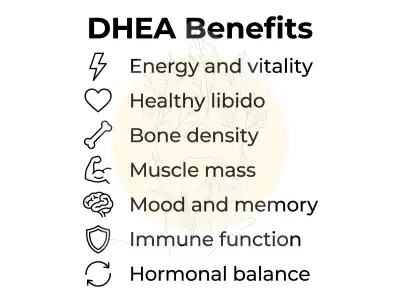
The benefits of DHEA are well supported in a few areas, limited in others and unproven in the rest. Here is how they sort out.
DHEA works as a precursor to testosterone and estrogen and as a hormone with direct effects on inflammation, insulin sensitivity and immunity. Researchers note that the clinical value of supplements still needs more study.
Well Supported
Intravaginal DHEA (prasterone) is FDA-approved for painful intercourse caused by menopause-related vaginal changes. In adrenal insufficiency, DHEA can give small improvements in quality of life and mood.
Limited or Mixed
Evidence for mood, bone density and sexual function is thinner. Reviews show minor effects at best, and bone gains are smaller than with estrogen therapy.
Not Supported
Reversing aging, improving memory in healthy adults and treating infertility lack good evidence.
Because results depend on your baseline levels, testing comes before supplementing. The next sections show how this plays out for women and men.
DHEA Benefits for Women
DHEA benefits for women are clearest after menopause, when ovarian hormone production falls and your adrenal glands keep making DHEA. Your tissues convert it into estrogen and testosterone as needed. The benefits of DHEA for women vary a lot by form, so the evidence is easiest to follow in three parts.
Vaginal And Sexual Health
Intravaginal DHEA (prasterone) is FDA-approved for painful intercourse in menopause. Reviews show it improves vaginal pH and relieves painful intercourse. Oral DHEA has not shown the same results, and systematic reviews found no improvement in libido.
Bone And Skin Health
DHEA may add small gains in bone mineral density, but these are well below what estrogen therapy achieves. Evidence for skin hydration and collagen is limited, so treat it as a possibility, not a promise.
Mood And Energy
Reviews find minor, low-quality effects on mood, with the clearest gains in adrenal insufficiency. If you feel tired or low, test first. DHEA-S can show whether low levels are a factor, and other causes can be ruled out.
Because DHEA converts into testosterone and estradiol, researchers raise long-term breast cancer and cardiovascular concerns for postmenopausal women. That is why monitoring matters, and why men’s use looks different, which comes next.
DHEA Benefits for Men
DHEA for men matters most as natural hormone levels decline during andropause. Your testes make most of your testosterone for life, but adrenal DHEA adds to your overall androgen supply and becomes more relevant with age. Evidence for supplements is mixed, and men with normal testosterone typically see little change.
When Testing Matters
Because DHEA for men works best when there is an actual deficit to correct, testing DHEA-S levels before supplementation is essential. This ensures you are addressing a real imbalance rather than adding hormones your body does not need.
Signs of Low DHEA Levels
As DHEA declines naturally with age, many people develop symptoms that overlap with general aging but may actually reflect a correctable hormone deficit. Low DHEA levels are also associated with adrenal insufficiency, chronic stress, severe illness and certain medications like corticosteroids.
Common Symptoms
- Persistent fatigue and low energy
- Decreased libido and sexual dysfunction
- Loss of muscle mass and strength
- Increased abdominal fat
- Low mood, irritability or depression
- Dry skin and reduced skin elasticity
- Joint discomfort
Conditions Linked to Low DHEA
According to MedlinePlus, low DHEA-S levels may indicate:
- Addison disease (primary adrenal insufficiency)
- Hypopituitarism (underactive pituitary gland)
- Chronic fatigue syndrome
- Severe systemic illness or prolonged stress
If you are experiencing several of these symptoms, testing your DHEA sulfate levels can help determine whether low DHEA is a contributing factor or whether other conditions need to be ruled out.
Signs of High DHEA Levels
While low DHEA gets more attention, elevated DHEA can cause significant symptoms, particularly in women. High DHEA signals excess androgen activity and may point to an underlying condition that requires evaluation.
Symptoms in Women
High DHEA sulfate in females often presents with androgenic symptoms including:
- Acne along the jawline, chest and back
- Oily skin and clogged pores
- Excess facial and body hair (hirsutism)
- Thinning hair on the scalp (androgenic alopecia)
- Irregular or missed periods
- Difficulty conceiving
- Deepening voice in severe cases
Symptoms in Men
Men with high DHEA may not notice obvious symptoms since their baseline androgen levels are already higher. In some cases, elevated levels may contribute to acne, oily skin or mood changes.
Conditions Associated with High DHEA
- PCOS (polycystic ovary syndrome) – the most common cause in women
- Congenital adrenal hyperplasia
- Cushing syndrome
- Adrenal tumors (suspected when levels are extremely high or symptoms develop rapidly)
Mild elevations are often idiopathic or stress-related. However, DHEA-S levels above 600 mcg/dL warrant further investigation to rule out an androgen-secreting adrenal tumor.
DHEA Testing: The DHEA Sulfate Blood Test
The most reliable way to assess your DHEA status is through a DHEA sulfate blood test. Providers measure DHEA-S rather than unconjugated DHEA because the sulfated form is far more stable and does not fluctuate throughout the day like other hormones.
What to Expect During DHEA Testing
A DHEA blood test requires a simple blood draw from a vein in your arm. No fasting is required, and the procedure takes less than five minutes. Results are typically available within a few days.
Normal Reference Ranges
According to Mount Sinai, normal DHEAS levels vary significantly by age and sex:
| Age | Women (mcg/dL) | Men (mcg/dL) |
|---|---|---|
| 18-29 | 45-320 | 280-640 |
| 30-39 | 40-325 | 120-520 |
| 40-49 | 30-280 | 95-530 |
| 50+ | 20-200 | 70-310 |
Levels decline steadily after the mid-20s, so interpreting results requires considering your age and symptoms, not just where you fall in the range.
Other Hormones Often Tested Alongside DHEA-S
A DHEA lab test is rarely done in isolation. Your provider may also order:
- Total and free testosterone
- Estradiol
- Cortisol
- LH and FSH
- Thyroid panel (TSH, free T3, free T4)
- Fasting insulin
This broader panel helps identify whether low or high DHEA sulfate is part of a larger hormonal imbalance.
DHEA Supplementation
In the United States, DHEA supplement products are classified as dietary supplements and available over the counter without a prescription. This makes DHEA supplements widely accessible, but it also means quality control varies significantly between brands.
Forms Available
Dietary supplement DHEA comes in several forms:
- Oral capsules and tablets (most common)
- Sublingual tablets (dissolve under the tongue)
- Topical creams and gels
- Micronized powder
Prescription DHEA (prasterone) is FDA-approved as an intravaginal insert for treating vaginal atrophy and painful intercourse in postmenopausal women.0
Typical Dosing
There is no universally agreed-upon dose for DHEA supplements. Most studies use doses ranging from 25 mg to 100 mg daily. Women typically require lower doses (10-25 mg) than men due to greater sensitivity to androgens.
When choosing the best DHEA supplement, look for products that have been third-party tested for purity and potency.
Medical Supervision Matters
Because DHEA is a hormone that converts into testosterone and estrogen, supplementing without monitoring can lead to unintended side effects. Your provider should check baseline DHEA-S levels before starting and retest periodically to ensure levels stay within a healthy range. DHEA-S also stays in your blood far longer than unconjugated DHEA, so a test can still read elevated after your last dose.
When to Take DHEA: Morning or Night
The best time to take DHEA depends on your goal and how your body responds, and there is no single clinical standard. Most providers choose between two sensible options.
Taking DHEA in the Morning
Your adrenal glands release DHEA under the same ACTH signal that drives cortisol. Both follow a daily rhythm, so a morning dose mirrors what your body already does. This is why many providers start there. Morning also keeps the dose away from sleep if you notice any extra alertness.
Why Take DHEA at Night
If you are wondering why take DHEA at night, the reasons are practical. Some people find a morning dose too stimulating. Others, and some providers, prefer evening dosing to support overnight recovery. Because DHEA converts to testosterone and estrogen, a late dose can leave some people feeling wired at bedtime. If that happens, move it earlier.
Whichever time you choose, keep it consistent and retest your DHEA-S so your dose follows your results, not a guess.
DHEA Side Effects
Because DHEA converts into testosterone and estrogen, supplementation can produce androgenic or estrogenic effects depending on your body’s conversion pathways. Most DHEA side effects are dose-dependent and reversible when supplementation is reduced or stopped.
Common Side Effects
- Oily skin and acne
- Hair loss on the scalp
- Facial hair growth in women (hirsutism)
- Deepening voice in women
- Mood changes, irritability or agitation
- Decreased HDL (good) cholesterol
Who Should Avoid DHEA
DHEA supplementation is not appropriate for everyone. You should avoid DHEA or use it only under close medical supervision if you have:
- History of hormone-sensitive cancers (breast, ovarian, prostate)
- Liver disease
- Diabetes or blood sugar imbalances
- Mood disorders including bipolar disorder
- PCOS (may worsen androgen excess)
Drug Interactions
- Estrogen and testosterone therapy
- Insulin and diabetes medications
- Antipsychotics and lithium
- Selective serotonin reuptake inhibitors (SSRIs)
- Corticosteroids
Frequently Asked Questions on DHEA
How Do You Treat High DHEA Levels in Females?
Treating high DHEA levels in females starts with identifying the underlying cause. If PCOS is the driver, addressing insulin resistance through diet, exercise and supplements like myo-inositol or berberine often helps lower androgen levels. For adrenal causes, stress management and adaptogen support may be beneficial. In some cases, oral contraceptives or anti-androgen medications like spironolactone are prescribed. Work with your provider to determine why levels are elevated before pursuing treatment.
Does DHEA Increase Testosterone?
Yes, DHEA can increase testosterone, but the effect varies by sex and baseline hormone status. DHEA supplementation significantly raises testosterone levels, with a greater effect in women than men. Younger men with normal testosterone typically see little to no increase.
How To Treat Low DHEA Levels in Females?
Treating low DHEA in women may involve oral supplementation under medical supervision, typically at doses between 10-25 mg daily. Supporting adrenal health through stress reduction, adequate sleep and adaptogenic herbs can also help. Your provider should monitor DHEA-S levels and watch for androgenic side effects like acne or hair changes.
Does DHEA Cause Weight Gain?
No, weight gain is not a typical DHEA side effect. Low DHEA is more often linked to extra abdominal fat. If your weight changes after you start DHEA, tell your provider, because your dose and your other hormones may need adjusting.
Does DHEA Cause Hair Loss?
DHEA can contribute to hair loss in individuals who are sensitive to androgens. When DHEA converts to testosterone and then to DHT (dihydrotestosterone), it may trigger androgenic alopecia in genetically predisposed individuals. This side effect is dose-dependent and more common in women. If you notice scalp thinning while taking DHEA, consult your provider about adjusting your dose.